
Jack Kerouac and Jazz
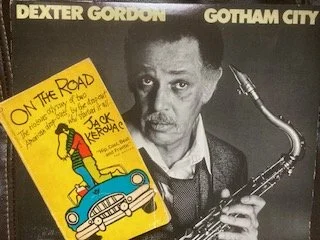
Dexter Gordon album and Kerouc book. Photo by author
I first came across Jack Kerouac’s “On the Road” when I was in high school. Like many young males, I was enthralled by the book. I loved reading about my then-home, Nebraska, as Kerouac chronicled his travels through the state and experiences in towns I knew: Omaha, Grand Island, North Platte, all the way to Denver. The next summer, I did my own hitching, over to Denver, up to Montana, down to Yellowstone and across Wyoming and South Dakota and back to Nebraska.
But hitchhiking wasn’t the only thing. The book was also, in a way, a first introduction to jazz. Kerouac has many passages where he writes about the music and drops the names: Dexter Gordon, Billie Holiday, Dizzy Gillespie, Charlie Parker. He helped make bebop the soundtrack to what we call the Beat Generation.
A few quotations (all page numbers from the title referenced at the end):
“My mind was filled with that great song, ‘Lover Man,’ as Billie Holiday sings it; I had my own concert in the bushes . . . It’s not the words so much as the great harmonic tune and the way Billie sings it, like a woman stroking her man’s hair in soft lamplight. The winds howled. I got cold.” (page 83)
“. . .listening to a wild bop record I had just bought called ‘The Hunt,’ with Dexter Gordon and Wardell Gray blowing their tops before a screaming audience that gave the record fantastic frenzied volume.” (page 94)
“Slim sits down at the piano and hits two notes, two Cs, then two more, then one, then two, and suddenly the big burly bass-player wakes up from a reverie and realizes that Slim is playing ‘C-Jam Blues’ and he slugs in his big base fore-finger on the string and the big booming beat begins and everybody starts rocking . . .”(age 146)
“Once there was Louis Armstrong blowing his beautiful top in the muds of New Orleans; before him the mad musicians who had paraded on official days and broke up their Sousa marches into ragtime. Then there was swing, and Roy Eldridge, vigorous and virile, blasting the horn for everything it had in waves of power and logic and subtlety—leaning into it with glittering eyes and a lovely smile and sending it out broadcast to rock the jazz world . . . Then had come Charlie Parker, a kid in his mother’s woodshed in Kansas City, blowing his taped-up alto among the logs, practicing on rainy days, coming out to watch the old swinging Basie and Benny Moten band that had Hot Lips Page and the rest—Charlie Parker leaving home and coming to Harlem, and meeting mad Thelonious Monk and madder Gillespie—Charlie Parker in his early days when he was flipped and walked around in a circle while playing . . . and you had to look around to see where the solo was coming from, for it came from angelical smiling lips upon the mouthpiece and it was a soft, sweet, fairy-tale solo on an alto. Lonely as America, a throatpierced sound in the night.” (pages 197-198)
You can just about hear the music.
And, of course, you can listen to the music. In this AI/Internet age we’re living in, someone has already compiled an “On the Road” playlist, which saves me a bit of work.
Listen to the “On the Road” playlist.
—————————————
Kerouac, Jack. 1955, 1957. On the Road. Signet: New York. Seventeenth Printing.