
Miles Davis and Louis Malle’s “Ascenseur Pour L'Échafaud”
Miles Davis’ sparse yet haunting soundtrack to Louis Malle’s “Ascenseur Pour L'Échafaud” (Elevator to the Gallows) is as famous as the film itself.
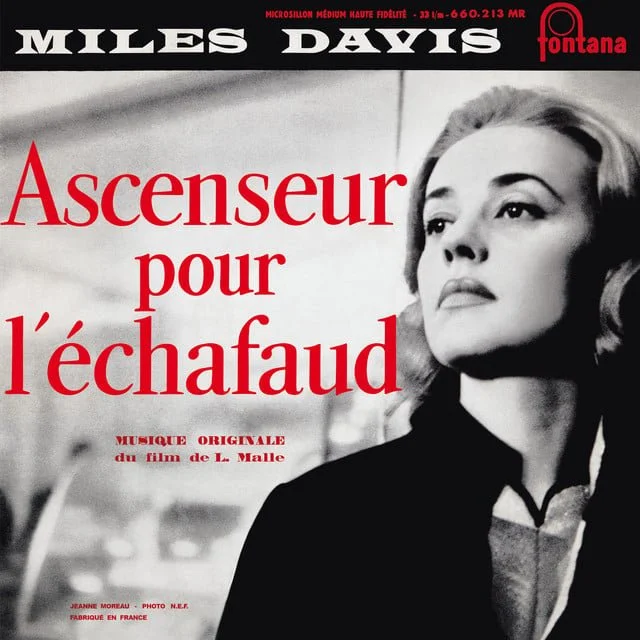
The film starts with an extreme close-up of Florence (Jeanne Moreau) on the phone, telling someone she loves him. Then a close-up of Julien (Maurice Ronet), telling Moreau he loves her. A lone trumpet cries, backed by a sultry rhythm section.
Welcome to “Elevator to the Gallows,” a 1958 film by Louis Malle, with a soundtrack by Miles Davis.
As the camera draws back, the initial credits roll, and we see Julien in the office where he works. Miles’ trumpet continues its slow-moving stroll. As the credits end, the trumpet fades, and we’re back to the close-ups. A rendezvous is set.
Julien goes to see his boss. The trumpet blares, then tapers back to a slow pace, with larger gaps between the notes. What’s it leading up to? Murder.
A soundtrack plays many roles in a movie. It can heighten suspense, foreshadow what’s coming, and provide release. Davis created a punctual soundtrack. It’s not a list of hits to monetize. There is really very little music in the film. But when music comes in, it fills in the gaps and provides an aural texture.
And it works. The soundtrack doesn’t take over the movie. Malle’s film noir is the story: dark images, twisty plot, urban grit, the wealthy but broken, punks who flaunt the law, and tough cops. But the music provides accent, mood, and emotion. You can feel the excitement and adventure of Louis and Veronique on “Sur L’Autoroute” and the bluesy, sparse, lonely, and emotional ride of Florence on “Florence Sur Les Champs-Élyseés.”
Just as jazz musicians work with but never outshine the soloist, the quintet backs up the movie—always in the background.
Miles recorded the soundtrack in Paris in 1957, preceding “Kind of Blue.” But it’s that kind of music: improvisational. And indeed, in the recording studio, Davis gave the band only a few chords to work with. The musicians were shown scenes from the film and asked to play. This is the soundtrack. Nothing but improvisation.
Listening to the album independent of the film, I hear “Bebop” Miles and a “new Miles”: a sparse Miles, who doesn’t play fast but takes his time to tease out what he wants to say. While bebop reigns in the more lively, social parts of the film (“Sur L’Autoroute” and “Dîner Au Motel,” for example), the new Miles is heard in the drawn-out improvisations in the darker scenes of the film. Examples here are “Générique,” and “Chez Le Photographe Du Motel.” The bass especially plays a large role with new Miles, building suspense and setting the tone in “Évasion De Julien” and “Visite Du Vigile.”
It’s hard to separate a film from the soundtrack. But the recording by Miles would stand up without the film. But would the film be the same without it?
Notes
The soundtrack was on one side of Davis’ “Jazz Track” album, which was nominated for a Grammy in the Best Jazz Performance, Solo or Small Group category in 1961.
More on the movie and soundtrack: https://www.rogerebert.com/mzs/30-minutes-on.
See a short clip of Davis recording the soundtrack, with Louis Malle explaining what is happening: https://www.milesdavis.com/albums/ascenseur-pour-lechafaud/
You can rent or purchase the film on Amazon Prime Video or find it through many streaming services.
Personnel
Miles Davis, trumpet
Barney Wilen, tenor saxophone
Rene Urtreger, piano
Pierre Michelot, bass
Kenny Clarke, drums
Tracks
A1, Générique, 2:45
A2, L'Assassinat De Carala, 2:10
A3, Sur L'Autoroute, 2:15
A4, Julien Dans L'Ascenseur, 2:07
A5, Florence Sur Les Champs-Élyseés, 2:50
B1, Dîner Au Motel, 3:58
B2, Évasion De Julien, 0:53
B3, Visite Du Vigile, 2:00
B4, Au Bar Du Petit Bac, 2:50
B5, Chez Le Photographe Du Motel, 3:50
—————————————-
Ascenseur Pour L'Échafaud. Discogs. https://www.discogs.com/master/64650-Miles-Davis-Ascenseur-Pour-L%C3%89chafaud?. Retrieved 15:29, August 8, 2026.